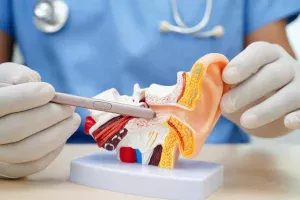




A perforated eardrum can develop after a chronic ear infection, injury, sudden pressure change, or other problems affecting the middle ear. While some small perforations may heal naturally, a hole that persists can contribute to repeated ear discharge, hearing difficulty, or vulnerability to further infection. Eardrum Repair Surgery in Bangalore may be considered when the perforation does not heal or when repair is needed to protect the middle ear and improve hearing. At Svastii, Bangalore, patients with persistent eardrum perforations can undergo a detailed ENT assessment to understand the size and location of the perforation, the condition of the middle ear, hearing status, and whether tympanoplasty is appropriate. The surgical plan is individualized rather than assuming that every eardrum perforation requires the same procedure.
What Is Tympanoplasty?
Tympanoplasty is a surgical procedure performed to repair a perforated or damaged eardrum.
The eardrum, also called the tympanic membrane, separates the outer ear canal from the middle ear. It plays an important role in transmitting sound vibrations toward the tiny hearing bones within the middle ear.
When there is a persistent opening in the eardrum, sound transmission may be affected. In addition, water or bacteria can enter the middle ear more easily, potentially contributing to recurrent infections.
The purpose of tympanoplasty is therefore not simply to “close a hole.” The surgeon considers the condition of the eardrum, middle-ear structures, hearing mechanism, and any ongoing infection before deciding how the repair should be performed.
Why Might an Eardrum Need Surgical Repair?
Not every perforated eardrum needs an operation.
Some perforations may close naturally, particularly when they are small and the underlying cause has been treated. Surgery may be considered when a perforation persists or when there are additional concerns.
Possible reasons for considering tympanoplasty include:
- A persistent eardrum perforation
- Repeated ear infections
- Recurrent ear discharge
- Conductive hearing loss associated with the perforation
- A perforation that does not show signs of healing
- An eardrum defect that makes the middle ear vulnerable to water or infection
- Damage associated with previous ear disease
The decision depends on the individual patient’s examination and hearing assessment.
What Happens Before Eardrum Repair Surgery?
The surgical procedure begins well before the patient enters the operating room.
1. Detailed Ear Examination
The ENT surgeon examines the ear to determine where the perforation is located and how extensive it is.
The doctor may assess:
- The size of the perforation
- Its position on the eardrum
- The condition of the remaining eardrum
- Signs of infection or inflammation
- The appearance of the ear canal
- The condition of the middle ear where it can be assessed
This examination helps determine whether tympanoplasty is appropriate and what type of repair may be required.
2. Hearing Assessment
A hearing test is commonly important when evaluating a patient with an eardrum perforation.
An audiological assessment can help determine whether hearing loss is present and whether it appears to be conductive, sensorineural, or mixed.
The hearing findings can also help the surgeon understand whether the eardrum is the only structure affecting hearing or whether the small middle-ear bones may also need assessment.
3. Treating Active Infection
If there is active infection or significant ear discharge, the ENT specialist may first address the infection and inflammation.
Operating on an actively infected ear is not appropriate in every situation, so the timing of surgery depends on the individual clinical findings.
4. Choosing the Surgical Approach
Once the ear has been assessed, the surgeon determines the most suitable surgical route.
Svastii’s Ear Institute describes endoscopic tympanoplasty as one of the applications of endoscopic ear surgery for suitable patients with eardrum perforations associated with conditions such as chronic otitis media.
However, the choice between surgical approaches should be based on the patient’s anatomy, disease, perforation characteristics, and the surgeon’s assessment.
How Is Tympanoplasty Performed?
The exact technique varies according to the location and extent of the perforation.
In general, the surgeon first gains access to the eardrum and carefully prepares the edges of the perforation. A suitable graft material is then positioned to bridge the defect.
Step 1: Accessing the Eardrum
The surgeon accesses the affected area through the ear canal or by another appropriate surgical route depending on the anatomy and planned technique.
With an endoscopic approach, a small camera provides a magnified view of the ear canal and middle-ear structures. Svastii specifically highlights endoscopic ear surgery as a minimally invasive approach used for selected ear conditions.
Step 2: Preparing the Perforation
The edges around the perforation are prepared carefully so that the graft can integrate with the existing eardrum tissue.
The surgeon also checks the middle ear for abnormalities that may influence the repair.
Step 3: Placing the Graft
A graft is positioned over or beneath the damaged portion of the eardrum, depending on the surgical technique.
The graft acts as a framework over which the patient’s own tissue can heal and form a new, continuous tympanic membrane.
The choice and placement of the graft depend on the size, position, and characteristics of the perforation.
Step 4: Supporting the Repair
The graft may be supported using appropriate surgical materials while healing begins.
The surgeon’s objective is to create a stable repair that can restore the barrier between the outer ear canal and middle ear and, where possible, support better sound transmission.
Step 5: Completing the Procedure
Once the repair is appropriately positioned, the surgical area is completed and the patient is moved to recovery for monitoring.
The exact duration and postoperative plan vary according to the technique and the complexity of the ear condition.
Can Tympanoplasty Also Improve Hearing?
It can, particularly when the hearing loss is related to the perforated eardrum and associated middle-ear problems.
However, hearing improvement cannot be guaranteed for every patient.
Hearing may continue to be affected if there is damage involving the middle-ear bones, longstanding inflammation, inner-ear problems, or another condition unrelated to the eardrum itself.
This is why a hearing test and complete ear evaluation are important before surgery.
What Is Recovery Like After Eardrum Repair?
Recovery differs from person to person.
Your ENT surgeon may advise you to:
- Keep the ear protected from water during the healing period
- Avoid inserting anything into the operated ear
- Follow prescribed medication instructions
- Attend scheduled follow-up appointments
- Avoid blowing the nose forcefully when advised
- Report unusual pain, bleeding, discharge, dizziness, or other concerning symptoms
The repaired eardrum needs time to heal. Hearing may not return immediately, and the final hearing result can take time to become apparent.
Following postoperative instructions carefully is an important part of protecting the repair.
What Are the Possible Risks?
Like any surgical procedure, tympanoplasty has potential risks. The specific risks depend on the patient’s condition and the surgical technique.
Possible complications can include:
- Persistent or recurrent perforation
- Infection
- Hearing changes
- Tinnitus
- Dizziness
- Altered taste sensation
- Graft healing problems
- Rarely, injury to structures involved in hearing or facial movement
Your ENT surgeon should discuss the expected benefits, alternatives, and potential risks before surgery.
Eardrum Repair Surgery in Bangalore: Why Individual Assessment Matters
For patients seeking Eardrum Repair Surgery in Bangalore, the most important step is obtaining an accurate diagnosis before deciding on surgery.
At Svastii, the approach to ear surgery includes detailed evaluation of the ear and hearing function before selecting an appropriate surgical technique. The institute’s published information describes advanced endoscopic ear surgery for selected conditions, including endoscopic tympanoplasty, while emphasizing visualization of delicate middle-ear structures.
Svastii’s ENT services are associated with (Prof.) Dr. Satish Nair, Professor, Senior Consultant and Academic Head of ENT at Manipal Hospitals Old Airport Road, Bangalore. The website describes his experience in ENT and advanced minimally invasive and endoscopic ear surgery.
The clinic’s listed location is in Bangalore, with its ENT and surgical services also associated with Manipal Hospitals Old Airport Road and Svastii’s centre at Apollo Hospitals Bannerghatta Road.
When Should You See an ENT Surgeon for a Perforated Eardrum?
Consider an ENT consultation if you have:
- Ear discharge that keeps returning
- Hearing difficulty following an ear infection
- A known hole in the eardrum that has not healed
- Repeated middle-ear infections
- Ear discomfort after an injury
- Persistent hearing changes
- Water entering the ear causing repeated problems
A persistent perforation should not simply be ignored. An ENT specialist can determine whether observation, medical treatment, hearing monitoring, or surgical repair is appropriate.
Frequently Asked Questions
1. Can every perforated eardrum be repaired with tympanoplasty?
Not necessarily. The decision depends on the size and location of the perforation, the condition of the middle ear, infection status, hearing level, and other clinical factors.
2. Does tympanoplasty always restore normal hearing?
No. Hearing improvement depends on why hearing has been reduced. If other middle-ear or inner-ear structures are affected, closing the perforation alone may not completely restore hearing.
3. Is endoscopic tympanoplasty suitable for everyone?
No. Endoscopic surgery can be useful for selected patients, but the appropriate approach depends on the anatomy and disease. Your ENT surgeon should determine which technique is suitable.
4. How long does a repaired eardrum take to heal?
Healing time varies between patients and depends on the size of the repair, surgical technique, overall ear health, and other factors. Your surgeon will monitor the repair during follow-up visits.
5. Can I get water into my ear after tympanoplasty?
Patients are generally advised to protect the operated ear from water while the repair is healing. Follow the specific precautions given by your ENT surgeon.
Conclusion
Tympanoplasty is more than simply covering a hole in the eardrum. Successful repair involves understanding the cause of the perforation, evaluating hearing and middle-ear health, selecting an appropriate surgical approach, positioning the graft carefully, and allowing adequate time for healing.
If you have a persistent eardrum perforation, recurrent discharge, or hearing difficulty, an ENT evaluation can help determine whether surgical repair is appropriate for you.
Looking for Eardrum Repair Surgery in Bangalore?
If you have a persistent eardrum perforation, recurrent ear discharge, or hearing difficulty, consult an experienced ENT Surgeon for Eardrum Repair in Bangalore for a detailed ear and hearing assessment.
For Eardrum Repair Surgery in Bangalore, contact Svastii to understand whether tympanoplasty or another ear treatment is appropriate for your condition.
Svastii – The Ear Institute
Bangalore
Specialized care for ear and ENT conditions with advanced endoscopic surgical expertise.